
Suns overwhelm Jazz in a wire-to-wire rout, and the urgency is starting to feel real 134-109


The Suns did not tiptoe into this one. They kicked the door open.
Phoenix rolled past the Utah Jazz 134-109 on Saturday night, delivering the kind of performance that felt decisive almost from the jump. It was fast, forceful, and for long stretches, borderline relentless. The Suns ripped off a 21-2 run in the first quarter, buried Utah under a barrage of early shots, and never gave the game back.
By halftime, the score was 73-45, the Suns’ biggest halftime lead of the season. That number alone tells the story, but it does not fully capture the tone inside the building. This was a team playing with rhythm, confidence, and a clear understanding of what was at stake late in the season.
With the win, the Suns moved within 3 1/2 games of sixth-place Houston, the final spot that avoids the Western Conference play-in round. In other words, this was not just another regular-season victory. It was a response. It was a statement. And most of all, it was the kind of night Phoenix badly needed.
Suns set the tone early and never looked back
The first quarter was when everything changed.
Utah came out with some life, getting early buckets from Brice Sensabaugh and Kyle Filipowski. For a few minutes, it looked like the Jazz might at least make Phoenix work. Then the Suns hit the gas.
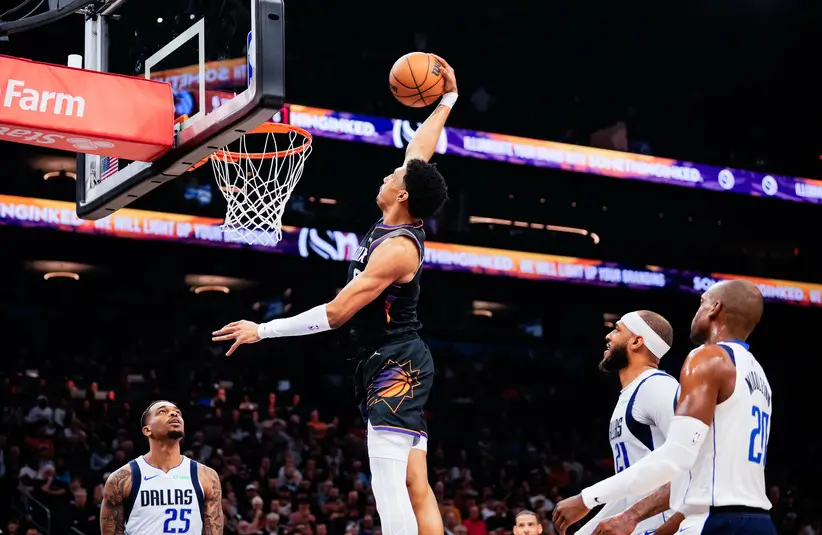
Jalen Green sparked the burst with his shot-making and downhill pressure. Devin Booker settled the offense, picked his spots, and let the game come to him. Grayson Allen found space on the perimeter and made Utah pay. Suddenly, a tight game turned into a runaway.
Phoenix ended the first quarter up 39-21 after drilling eight 3-pointers in the period. That kind of start does more than build a lead. It changes body language. It forces desperation earlier than any team wants to feel it.
By the time the second quarter settled in, the Suns were in complete control.
Jalen Green and Devin Booker lead the Suns attack
The Suns got exactly what they needed from their stars, and then some.
Green poured in 31 points on 13-of-22 shooting, adding six rebounds and three assists. He was explosive early, polished throughout, and never looked rushed. He scored 11 in the first quarter and had 20 by halftime, setting the tone for Phoenix’s offensive avalanche.
Booker added 26 points and eight assists in one of those smooth, composed performances that can sometimes get overlooked because he makes hard things look easy. He attacked the paint, got to the line, and kept the Suns organized. The game never felt too fast for him because it rarely does.
The best part for Phoenix might have been this: neither Green nor Booker needed to play in the fourth quarter. When your two primary scorers can sit out the final period because the work is already done, that is about as good as it gets this time of year.
Allen chipped in 19 points and knocked down four 3-pointers. Oso Ighodaro was perfect from the field, finishing with 13 points and eight rebounds on 6-of-6 shooting. Khaman Maluach added 12 points and nine rebounds, helping the Suns dominate the glass.
That rebounding edge was massive. Phoenix finished with 68 total rebounds to Utah’s 47, including 21 offensive boards. That is not just effort. That is control.
Suns win with depth, energy, and second-chance pressure
This was not a one-man show. The Suns won like a team that understood the assignment.
Phoenix shot 50 percent from the field, handed out 29 assists, and kept pressure on Utah with wave after wave of activity. Even when shots did not fall from deep at an elite clip overall, the Suns continued to generate good looks and even better possessions. They got extra chances on the offensive glass, protected the ball well enough, and turned their athleticism into momentum.
Jordan Goodwin added eight points and nine boards. Rasheer Fleming brought energy off the bench. Collin Gillespie did not score, but he handed out seven assists and helped keep the machine moving.
Those details matter. Blowouts are often built on star power, but they are sustained by role players who defend, rebound, cut hard, and make the extra pass. The Suns got all of that.
Utah had bright spots, but the Suns were too much
To Utah’s credit, there were a few notable individual efforts.
Sensabaugh scored 26 points, and Filipowski matched him with 26 of his own. Both players kept competing even after the game tilted heavily in Phoenix’s favor. But the Jazz were simply too undermanned and too overwhelmed to turn those performances into anything meaningful on the scoreboard.
Utah came into the night missing several players, including Lauri Markkanen, Isaiah Collier, Keyonte George, Walker Kessler, and Jaren Jackson. Against a Suns team that was locked in from the opening quarter, that was always going to be a difficult equation.
And once Phoenix built that first-half cushion, the Jazz were left chasing a game that had already slipped away.
What this win means for the Suns
The Suns are still chasing position, still trying to sharpen their edge, and still searching for consistency at the right time. But games like this can matter beyond the standings.
This was a reminder of what the Suns look like when the pace is right, the stars are in sync, and the supporting cast brings force. It was also a glimpse of a team that understands the urgency of the moment. Phoenix knows the margin is thin in the West. Every win matters. Every slip hurts.
Before the game, Suns coach Jordan Ott said Dillon Brooks and Mark Williams had both participated in 5-on-5 drills and could return during the upcoming four-game road trip. That is another encouraging sign for a team that may be getting healthier just as the race tightens.
For one night, though, the Suns did not need reinforcements. They had more than enough.
They came out swinging, buried the Jazz early, and never let the pressure off. In late March, style points do not count extra. But sometimes they do send a message.
The Suns sent one Saturday night.
