
Golden State Warriors Head Coach Steve Kerr Weighs In On Shortening NBA Season

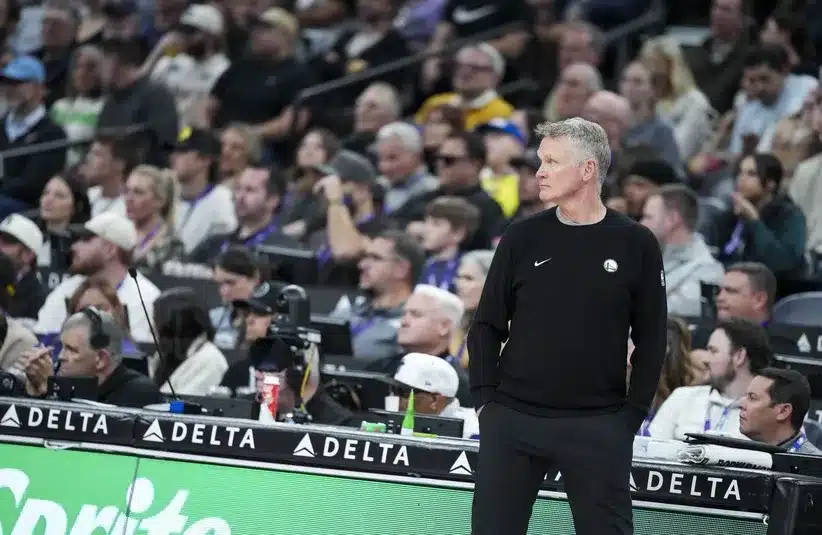
Steve Kerr has seen enough. After watching his Golden State Warriors limp through another injury-plagued Monday night, a 129-126 gut-punch loss to the Utah Jazz, of all teams, the championship coach stepped up to the podium and said what a lot of people in the league are quietly thinking but won’t say out loud.
“We need to take 10 games off the schedule,” Kerr said bluntly. “I think it would be a more competitive and healthier league if we played fewer games.” No hedging. No softening. Just Kerr, tired and honest, telling the truth in the way only someone with nothing left to prove can.
Why Kerr Keeps Pushing This Conversation
This isn’t a new talking point for Kerr. He’s been beating this drum for years, and every season the argument gets harder to ignore. The Warriors were without Stephen Curry, Jimmy Butler, Al Horford, Moses Moody, and Kristaps Porzingis on Monday night. Five players. Gone. That’s not a lineup — that’s a coaching staff and a prayer.
Kerr knows the injury problem isn’t random. It’s structural. The modern NBA game runs faster, covers more ground, and demands more from players than any previous era. According to ESPN Research, teams are averaging 115.2 points per game. That is the highest since the 1969-70 season. Players are covering 37.1 miles per game at an average speed of 4.29 mph, the longest distance and fastest speed since player tracking began back in 2013-14.
These guys aren’t running less. They’re running more. And they’re being asked to do it 82 times a year. “I know this will not be a popular opinion in the league office,” Kerr said, “but I will continue to say it because it’s obvious.”
Kerr’s Argument Goes Beyond Injuries
Here’s where it gets interesting. The injury angle is easy to understand — fewer games, less wear, healthier players. But Kerr’s case actually runs deeper than that. The 82-game schedule creates a season that doesn’t mean much until April. When teams are tanking before the All-Star break, when stars are sitting out back-to-backs in November, when a fined Jazz squad beats the Warriors on a Monday night, the regular season has a credibility problem.
Kerr’s solution? Make every game count. Cut 10 games, and suddenly a loss in December stings a little more. Teams can’t afford to mail in stretches of the schedule. Stars play because they have to. Fans get a product worth watching.
“What I know about the league, about coaching, about how hard it is to play the modern game with the pace and the space,” Kerr said, “I think it would be a more competitive and healthier league.” He’s not wrong. And deep down, most people in the league know it.
So Why Won’t It Happen?
Money. Full stop. Kerr acknowledged it himself: “I get it — it’s revenue, and you’d have to get everybody to agree to take a little less money, and that’s a really hard thing to do.”
The NBA signed a $76 billion media rights deal in 2024. Cutting 10 games doesn’t just mean fewer tickets sold; it means renegotiating with broadcast partners, convincing 30 ownership groups to voluntarily surrender home gate revenue, and getting the Players Association to accept a potential pay cut. That’s not a basketball decision. That’s a labor negotiation with billions of dollars on the table.
Commissioner Adam Silver has acknowledged the issue without embracing the solution. He’s pointed to a lack of data proving that fewer games would reduce injuries. For what it’s worth, the 82-game schedule has been a fixture of NBA basketball since 1967. That’s almost 60 years of tradition propped up by financial incentives that make reform feel impossible.
Kerr’s Legacy Gives Him The Right To Say This
It’s worth remembering who’s making this argument. Kerr isn’t some fringe voice complaining from outside the system. He coached the 2015-16 Warriors to a then-record 73 wins. He played for the 72-win Chicago Bulls. He has more championship rings than most franchises have banners.
When Kerr says the league would be better with fewer games, he’s not anti-basketball. He’s pro-basketball. There’s a difference. He wants the sport to be what it can be — competitive every night, with healthy stars, in meaningful games. Whether the league listens is another matter entirely. But Kerr will keep saying it. Because he’s right, and he knows it.
