
Bridges disappears late as Knicks search for answers in Game 3 loss


With the Knicks clinging to their hopes in the final seconds Thursday night, Mikal Bridges was back on the floor for one defensive possession. By then, though, the bigger story had already been written. Bridges had spent most of the second half on the bench, watching a one-point loss unfold and listening to the noise that always follows a playoff defeat in New York.
The Knicks fell 109-108 to the Hawks in Game 3, and the loss did more than hand Atlanta a 2-1 series lead. It exposed just how unsettled New York looked when the game tightened. It also put Bridges in an uncomfortable spotlight after one of the roughest playoff nights of his career. He finished scoreless in 21 minutes, posted a minus-26, and turned the ball over four times. For a player brought in to stabilize big games on both ends, it was the kind of stat line that jumps off the page for all the wrong reasons.
Bridges’ struggles put Knicks in a tough spot
This was not just an off-night shooting. Bridges never found a rhythm, never imposed himself, and never looked fully settled. Mike Brown pulled him early in the third quarter and turned to Miles McBride, who gave the Knicks more juice and more shot-making. That decision said plenty.
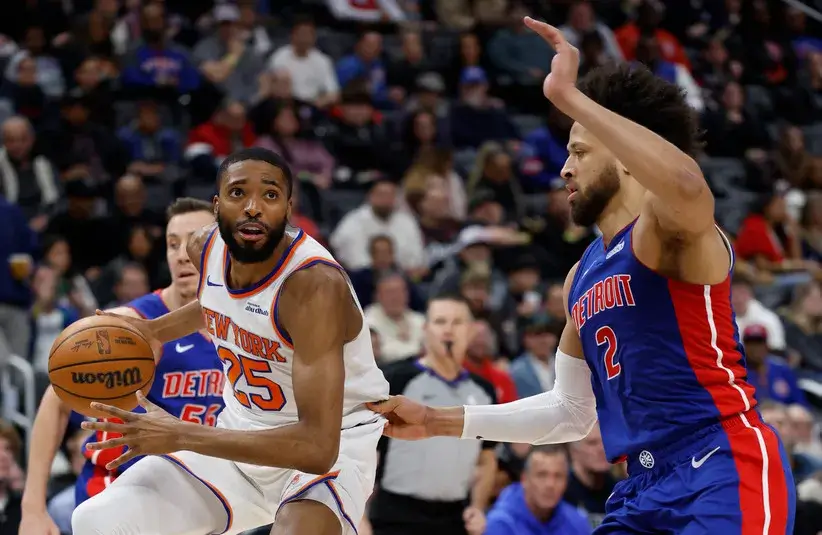
Brown stopped short of calling it a benching in any permanent sense, but in the middle of a playoff game, coaches do not make that move lightly. Bridges returned only for Atlanta’s final offensive trip, which ended with CJ McCollum burying a pull-up jumper with 12.5 seconds left to put the Hawks ahead for good. Afterward, Brown maintained his public support. “I’m not concerned about him,” Brown said. “I just went with what I felt the game called for that time. Mikal’s a pro. He’s played hundreds of basketball games, so he should be fine.”
That is the right message publicly. Still, the reality is hard to ignore. Bridges also struggled in the second half of Game 2, when he went scoreless and posted a minus-11 as Atlanta stormed back late. In back-to-back games, the Hawks have made him uncomfortable, and the Knicks have paid for it.
Why Bridges’ being scoreless matters for New York
Bridges was not acquired to be a background player in April. He was brought to New York because he is supposed to fit playoff basketball: defend multiple spots, make quick decisions, hit open shots, and keep the floor balanced around Jalen Brunson. Instead, Bridges has become part of the problem in this series.
New York gave up major draft capital to get him, and fair or not, that follows him into every quiet night. In the playoffs, expectations do not soften. They sharpen. Every possession gets examined. Every missed read feels louder. Every empty stretch feels longer. Bridges understood that after the game and did not duck it. “You know it’s going to suck. It is what it is. I’ve just got to be better to help my team out there.” That answer sounded honest. It also sounded like a player who knew there was no clear explanation for what just happened.
The Knicks lose composure late against an aggressive Hawks team
The Knicks were hardly undone by Bridges alone. Their late-game execution was messy, and that may be the most alarming part for a team that usually leans on poise. Brunson scored 26 points, but he missed all five of his 3-point attempts and was targeted defensively for the second straight game. On New York’s second-to-last possession, he air-balled a right-wing 3. On the final play, after McCollum’s go-ahead jumper, Brunson was swarmed near the baseline, and the game ended in a turnover before the Knicks could get organized. It was disjointed. Rushed. Uncharacteristic. “I got nothing right now.”
That was as revealing as anything said all night. The Knicks did get strong efforts elsewhere. OG Anunoby led them with 29 points and nine rebounds. McBride knocked down five 3-pointers and gave the team needed energy. But New York shot just 29% from deep, and when the game demanded calm, the Knicks looked rattled.
Atlanta, meanwhile, looked sharper and more forceful. The Hawks shot 39% from 3-point range and got an important lift from Jonathan Kuminga, who scored 21 points off the bench. His speed and activity repeatedly put New York on its heels. For the second straight game, the Hawks were the team dictating terms.
What Bridges and the Knicks must fix before Game 4?
The series is not over, and Brown was right to point that out. The playoff series swings quickly. Teams recover from 2-1 deficits all the time. But the pressure on New York is now real, and much of it lands on Bridges. He does not need a dramatic speech or some grand reinvention before Game 4. The Knicks need him to do the things he was brought here to do. Be clean with the ball. Defend with force. Cut decisively. Make the simple play. Knock down the shots that come from playing next to Brunson. Most of all, they need Bridges to look like himself again.
Because if Bridges stays stuck in neutral, the Knicks risk falling into a 3-1 hole and spending the next 48 hours answering questions about a trade, a rotation call, and a series suddenly slipping away. Game 3 was not just a bad night for Bridges. It was a warning sign for a Knicks team that looked frazzled when the pressure rose. And in the playoffs, once doubt enters the room, it rarely stays quiet for long.
