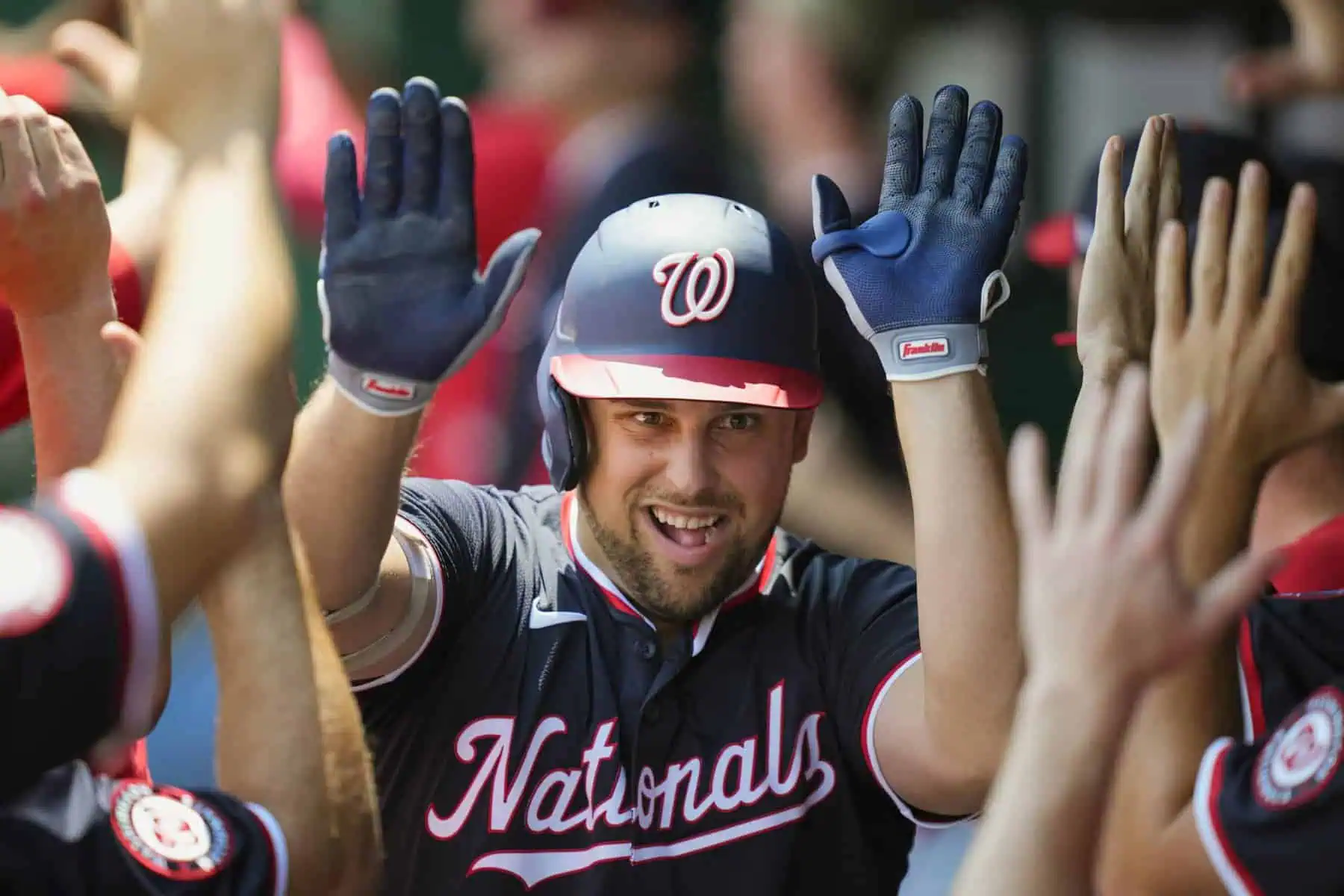
Washington Nationals DFA Nathaniel Lowe Hours After Career Game

Oh, the beautiful irony of professional baseball. One day, you are the hero, hitting your first career grand slam, and the next day, you are cleaning out your locker because your team decided they’d rather give a struggling prospect another shot. Welcome to the Washington Nationals’ latest head-scratching move involving Nathaniel Lowe.
The Sweet Taste Of Victory, Followed By the Bitter Sting Of Reality
Picture this: You’re 30 years old, you’ve been grinding in the majors for seven years, and Wednesday night finally delivers that magical moment every ballplayer dreams about. Lowe stepped into the batter’s box against the Kansas City Royals and absolutely crushed his first-ever grand slam. Not only did he go yard with the bases loaded, but he also drew two crucial walks later in the game, helping the Nationals squeeze out an 8-7 victory.
By any reasonable measure, this was the kind of performance that should buy you at least a few days of job security. According to win probability added, a fancy stat that measures how much a player actually helps his team win, this was the fifth-best game of Lowe’s entire career. The man was having one of his finest moments as a professional athlete. And then Thursday happened.
When Front Office Logic Meets Real-World Absurdity
The Washington Nationals, in all their rebuilding wisdom, decided that the perfect time to designate Lowe for assignment was exactly one day after his career highlight. Why? Because Dylan Crews, their 23-year-old outfield prospect, was coming off the injured list and they needed roster space.
Crews is hitting a robust .196/.266/.354 with 7 homers and 15 RBI. Those numbers are not just underwhelming, they are the kind of stats that would get a veteran player sent down to Triple-A faster than you can say “development time.” But because Crews is young and still has that shiny prospect label attached to his name, he gets the red-carpet treatment while Lowe gets shown the door.
The Numbers Don’t Lie (Even When Teams Ignore Them)
Sure, Lowe hasn’t exactly been lighting the world on fire this season. His .216/.292/.373 slash line isn’t going to win any batting titles, and those numbers explain why the Nationals felt comfortable making this move. But here is the thing about baseball that front offices sometimes forget: context matters.
Lowe has been worth a 104 wRC+ against right-handed pitching this season, which means he’s been above average in those situations. For a team that’s going nowhere fast in 2025, you would think having a veteran who can still produce against righties would be valuable. Not valuable enough to stick around after hitting the most memorable home run of his career.
The Cruel Mathematics Of Roster Management
The Nationals found themselves in an interesting pickle with their outfield situation. Between James Wood, Jacob Young, Crews, Robert Hassell III, and Daylen Lile, they had more outfielders than spots available. Instead of making the logical move of sending down one of their struggling young players to get more seasoning in the minors, they decided to sacrifice their starting first baseman instead.
Now they’re scrambling to fill that void at first base. Josh Bell, who’s been serving as their designated hitter, will likely slide back to his old position, where he’s made 858 career starts. They could also turn to Infielder Paul DeJong or Catcher Riley Adams, neither of whom screams “starting first baseman” on a major league roster.
A Silver Lining In This Mess?
Here’s where this story might not end in complete disaster for Lowe. Despite his struggles, there are plenty of contending teams that could use a veteran first baseman who can work counts and provide some pop against right-handed pitching. His $10.3 million salary might scare off some suitors, but for a playoff-bound team looking for depth, Lowe could be exactly what they need down the stretch.
The timing could not be better for him to showcase what he can still do. After all, nothing says “I’m ready to contribute to a winner” quite like launching a grand slam in clutch time. Some smart general manager is going to remember that moment when they’re looking for help in September.
The Washington Nationals: Masters of Questionable Timing
This move perfectly encapsulates everything frustrating about modern baseball front offices. They will preach about “process over results” and “long-term thinking” right up until they make decisions that seem to ignore both concepts entirely.
Designating a veteran player immediately after his best performance of the season sends a pretty clear message to the clubhouse. Individual achievements don’t matter if you don’t fit our demographic profile. It is the kind of move that makes you wonder if anyone in the front office actually watched that Wednesday night game or if they were too busy running spreadsheets to notice.
The Nationals are clearly in full rebuild mode, prioritizing youth development over competitive balance. That is a defensible strategy, but the execution here feels unnecessarily cruel. Couldn’t they have waited at least a week to let the man enjoy his moment? Baseball can be a harsh business, and Lowe just learned that lesson in the most brutal way possible. One day you’re the hero, the next day you’re looking for a new team.