
Tony Clark Resigns: Where Does MLBPA Go From Here?

Spring Training is supposed to be baseball’s collective deep breath. It’s the one time on the calendar when hope springs eternal, every pitcher is allegedly in the “best shape of their life,” and the only drama should be about a fifth starter spot or a new slider grip.
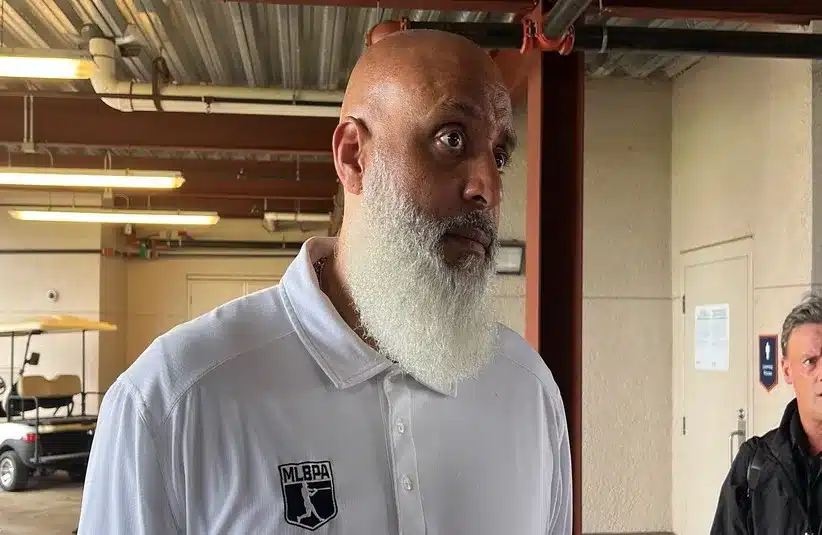
But this Tuesday, the baseball world didn’t get the crack of the bat. It got the thud of a resignation letter hitting a desk. Tony Clark, the 6-foot-8 former first baseman who made history as the first former player to lead the Major League Baseball Players Association (MLBPA), is stepping down.
The timing here is about as subtle as a high-and-tight fastball. With the collective bargaining agreement (CBA) set to expire on Dec. 1, Clark is exiting stage left right before the curtain rises on what promises to be a theater of war between the players and the owners.
The Complicated Legacy Of Tony Clark
When Clark took the reins in 2013, he was stepping into an impossible situation. He was succeeding Michael Weiner, a brilliant labor lawyer and a beloved figure who tragically passed away from a brain tumor. Weiner was a shark in a suit; Clark was a “player’s guy.” He brought a physical presence and an empathetic ear to the role, leading the union through the 2016 and 2022 negotiations.
But empathy doesn’t always win leverage battles. While Clark helped hold the line during the 99-day lockout in 2022, there has always been a whisper campaign questioning whether a former player had the tactical acumen to go toe-to-toe with the league’s lawyers.
Clark deserves credit for unifying the players during some dark times. He helped integrate minor leaguers into the union—a massive, historic win for labor rights in sports. But in the high-stakes game of billion-dollar industry politics, “good vibes” only get you so far.
Investigations and Internal Mutiny
So, why now? Why leave when the battle lines are being drawn? Well, follow the money. It usually leads to the answer. Clark and the MLBPA are currently staring down the barrel of a federal investigation by the Eastern District of New York. The Feds are looking into OneTeam Partners and Players Way, licensing ventures intended to generate revenue. There are allegations of financial impropriety and questions about whether union leaders were enriching themselves.
Beyond the legal headaches, Clark was fighting a war on his own front porch. Last year, we saw a rare, messy public attempted coup. A faction of players, spearheaded by lawyer Harry Marino, tried to oust Clark’s right-hand man, Bruce Meyer. While Clark survived that initial skirmish, and players like Jack Flaherty and Ian Happ were booted from leadership roles for the attempt, the scar tissue remained.
The Salary Cap Nightmare Awaits
The resignation of Clark leaves a vacuum at the worst possible moment. The owners, led by Commissioner Rob Manfred, are not hiding their intentions. They want a salary cap. They look at the spending habits of the Los Angeles Dodgers and the New York Mets, clutch their pearls, and cry poverty.
For the MLBPA, a salary cap is the third rail. It is the one thing they have vowed never to touch. The union has successfully resisted a cap for decades, making MLB the only major North American sport without one. The upcoming negotiation in 2026 was already predicted to be ugly, with Manfred hinting that an offseason lockout is a useful tool for “leverage.”
Now, the players are entering this buzzsaw without their figurehead. Meyer remains as the lead negotiator, but the optical loss of Clark is significant. The union needs to find a new voice, and fast. They cancelled their meeting with the Cleveland Guardians on Tuesday, a clear sign that things are in disarray.
What Comes Next?
Baseball will survive this. It survived the 1994 strike, the steroid era, and the Astros’ trash cans. But for the players, the next six months are critical. They need to close ranks, resolve the internal drama, and prepare for an ownership group that smells blood in the water.
Clark leaves behind a complicated legacy. He was the gentle giant who tried to lead with his heart in a business ruled by calculators. His departure marks the end of an era, and unfortunately for baseball fans, the beginning of what looks like a very long, very quiet winter.
