College Football Playoff Announces Important Dates For Upcoming Seasons

If you love the sport, get ready to test that devotion, because the new College Football Playoff schedule is officially here, and it is a marathon, not a sprint. We are talking about a season that now bleeds deep into late January. We’re talking about national champions being crowned a mere week before the NFL holds its own Super Bowl festivities.
The College Football Playoff unveiled the dates for the 2026-27 and 2027-28 postseasons this Tuesday, and let’s just say there are a few curveballs that will have fans and coaches checking their calendars twice.
The 2026-27 College Football Playoff Schedule Shake-Up
Let’s dive into the 2026-27 slate first, because that’s where things get a little weird. Traditionally, New Year’s Eve has been a staple for the playoffs. We’re used to popping champagne and watching kickoff. But for the 2026 season, the CFP is calling an audible. The first quarterfinal game is actually going down on Wednesday, December 30, 2026, at the Fiesta Bowl.
Why the shift to a Wednesday? You can thank the NFL. Since New Year’s Eve falls on a Thursday that year, the CFP wisely decided not to go head-to-head with “Thursday Night Football.” It’s a smart business move. Nobody wins when you try to fight the NFL shield for ratings.
The rest of the quarterfinals will follow the more traditional route, with a tripleheader on Friday, Jan. 1, 2027. The Cotton Bowl, Peach Bowl, and the “Granddaddy of Them All,” the Rose Bowl, will all take center stage to ring in the New Year.
The Two-Week Lull: A Momentum Killer?
Here is where the controversy really starts to brew. If you look at the gap between the quarterfinals and the semifinals, you might think it’s a typo. It’s not. The semifinals for the 2026-27 College Football Playoff won’t happen until mid-January. We’re talking about the Orange Bowl on Jan. 14 and the Sugar Bowl on Jan. 15.
That is a roughly two-week break. In the world of college athletics, that is an eternity. Historically, teams fight to stay in rhythm. A week off is rest; two weeks off is rust. While the extra recovery time is great for bumps and bruises, coaches are already sweating about keeping 18-22-year-olds focused for that long without a game. It disrupts the flow of the season entirely,
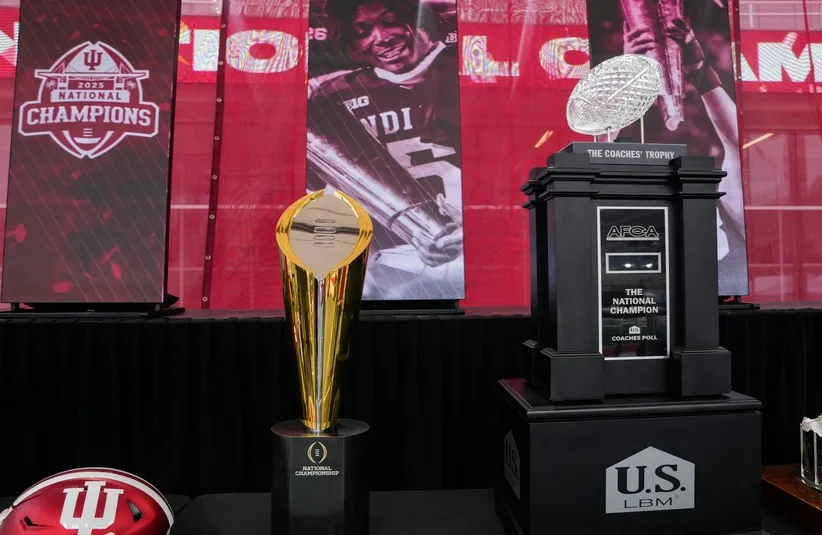
And the National Championship? That’s pushed all the way to Monday, Jan. 25, 2027, in Las Vegas.
Lane Kiffin Sounds Off
Not everyone is thrilled about this extended timeline. Lane Kiffin, never one to bite his tongue, took to social media to air his grievances.” Somehow the calendar got even worse on purpose,” Kiffin posted, clearly frustrated by the logistics. “Kids play until Jan 25th and have almost a month between the games?!?!”
He’s got a point. When you look at the human element, student-athletes balancing school, families trying to book travel on short notice, and the physical toll of a season that starts in August and ends in late January, it’s a massive ask. The excitement of the College Football Playoff expansion is undeniable, but the wear and tear on the roster is a very real concern for the guys wearing the headsets.
CFP Executive Director Rich Clark defended the move, citing “competitive balance” and maximizing the fan experience. But when you have a month-long gap scattered between games, you have to wonder if the casual fan might lose the plot line before the trophy is even hoisted.
Looking Ahead To 2027-28
The schedule normalizes a bit for the following season, but the late finish is here to stay. For the 2027-28 College Football Playoff, the quarterfinals return to New Year’s Eve with the Sugar Bowl on Dec. 31, 2027, followed by another New Year’s Day tripleheader (Fiesta, Peach, and Rose) on Jan. 1, 2028.
The semifinals stay deep in the calendar, landing on Jan. 13 and Jan. 14, with the title game set for Jan. 24, 2028, in New Orleans.
The Bottom Line
We are officially in a new era. The 12-team format is sticking around, and the calendar is stretching to accommodate it. For the die-hards, it means more meaningful football games in January. For the coaches and players, it means managing a season that is starting to look and feel a whole lot like an NFL schedule.