Carlos Alcaraz Defeats Novak Djokovic To Complete Career Grand Slam

For the better part of two decades, Rod Laver Arena has essentially been Novak Djokovic’s living room. He has the keys, he knows where the comfy chair is, and he generally doesn’t take kindly to guests trying to rearrange the furniture. But on a windy Sunday in Melbourne, Carlos Alcaraz didn’t just rearrange the furniture; he moved in, signed the lease, and changed the locks.
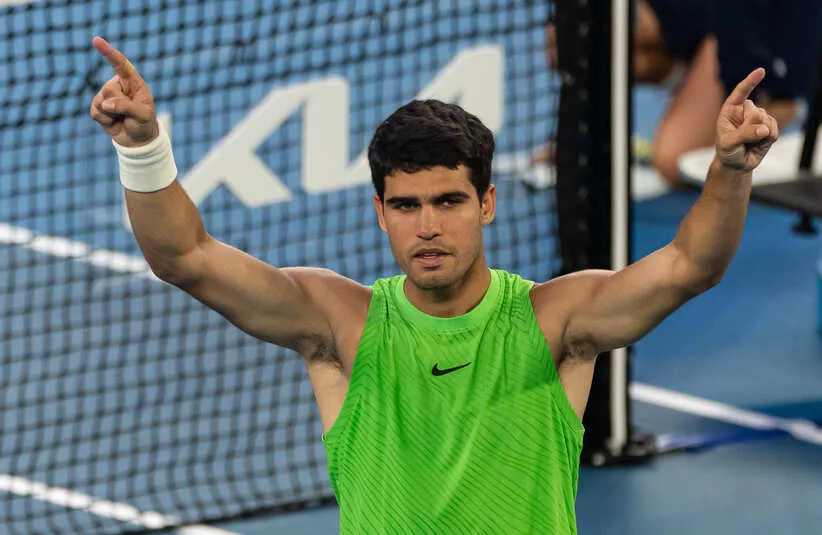
In a match that felt less like a tennis final and more like a changing of the guard ceremony performed at 100 miles per hour, the 22-year-old Spaniard defeated the 38-year-old Serbian legend 2-6, 6-2, 6-3, 7-5. In doing so, Alcaraz became the youngest man in the history of the sport to complete a career Grand Slam.
The First Set Fake-Out
If you tuned in early—or stayed up late, you probably thought we were watching a rerun. Djokovic came out of the gates looking like the Terminator. He was precise, he was brutal, and he took the first set 6-2 in just 39 minutes. It looked for all the world like he was marching toward his 25th major title and his 11th Australian Open.
But here’s the thing about Alcaraz: he has a short memory and very fast legs. While the “Old Guard” narrative looked ready to be written after that first set, the script flipped in the second. The wind was swirling, the conditions were tricky, and suddenly, the 16-year age gap between the two competitors became glaringly obvious.
Alcaraz started chasing down balls that had no business coming back over the net. He turned defense into offense with that trademark grin, practically daring Djokovic to hit a winner.
A Record That Stood Since 1938
By closing out the match, Alcaraz broke a record that has stood since before color television. At 22 years and 272 days old, he is the youngest man to win all four majors, besting Don Budge, who set the mark back in 1938. He beat Rafael Nadal to the punch by over a year.
It’s not just that he won; it’s how he did it. He had to go through Alexander Zverev in a five-hour marathon just to get to the final. Then, he had to stare down Djokovic, a man who had never lost an Australian Open final. He was a perfect 10-for-10 coming into Sunday.
The Final Set Drama
It wouldn’t be a major final without a little heart-stopping drama, right? In the fourth set, Djokovic, clearly fading but running on pure spite and championship DNA, saved break point after break point. He even called the trainer at one point, reminding everyone that while his spirit is immortal, his hamstrings are very much 38 years old.
The roof closed, the noise level in Melbourne spiked, and the tension was thick enough to cut with a racket. But when Alcaraz broke to go up 6-5, winning a 24-shot rally that featured some ball-striking that shouldn’t be possible by human beings, you could feel the air leave the balloon for Djokovic.
When the final forehand from the Serbian sailed long, Alcaraz collapsed to the court. It wasn’t just relief; it was the realization that he now stands alone at the top of the mountain.
What’s Next For the “Big One”?
Djokovic, gracious in defeat, joked that he’ll see Alcaraz “many more times in the next 10 years.” But make no mistake: this was the moment. The torch didn’t just get passed; it got ripped away in a four-set thriller. Alcaraz now has seven majors—two Wimbledons, two US Opens, two French Opens, and now, finally, the Australian crown.