Chess on Ice: Your Complete Guide to Curling at Milano-Cortina 2026

Every four years, television screens around the world light up with a sport that looks deceptively simple but is actually one of the most complex events at the Winter Games. It involves granite stones, vigorous sweeping, and a whole lot of shouting. We’re talking about curling.
For a few weeks, millions of viewers turn into armchair experts, analyzing ice friction and stone placement. But what is actually happening on that sheet of ice?
Understanding the “Roaring Game”
Curling is often nicknamed “Chess on Ice” as while it requires physical precision, it is fundamentally a game of strategy. The sport is played on a long, rectangular sheet of ice. The game centers on two teams taking turns sliding polished granite stones toward a circular target area known as the “house.”. Its quite fascinating too to see how those curling stones are made too.
The layout is straightforward. The house looks like a bullseye, and the very center is called the “button.” The goal isn’t just to hit the target; it is to have your stones resting closer to the button than your opponent’s when the “end” (the curling equivalent of an inning) is over.
The Team Formats
At Milano-Cortina 2026 Olympics, there are three distinct variations of the sport including: Men’s, Women’s, and Mixed Doubles.
In traditional team curling, four players take to the ice. The roles are simple, the Lead starts things off, the Second and Third (or Vice) build the play, and the Skip acts as the team captain, shouting instructions and delivering the final, crucial stones.
Mixed Doubles changes the pace significantly. It pairs one man and one woman, removing two players from the equation. This format is faster and often more aggressive. The emphasizing towards this curling event is to be quicker in tactical decisions and be more precise with the shot-making over defensive play.
The Science of Sweeping and Scoring In Curling
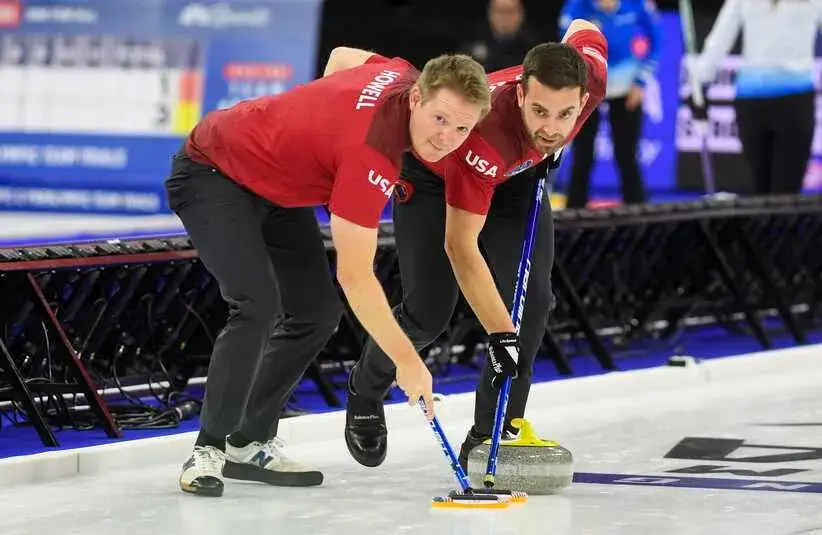
The most recognizable part of curling is the sweeping. It might look like aggressive janitorial work and Kenny Omega during his Bullet Club days in Japan, but it is actually high-stakes physics.
The most important part of the player delivering the stone, is that they put a rotation to it. That helps the stone to travel down the ice and its now up to the sweeper to reduce the friction. That is done through vigorously scrub the ice in front to slightly melt the surface so it can travel further and get the stone to where the player wants it to go. Good sweepers can drag a stone an extra ten feet or keep it on a razor-thin line to squeeze past a guard rock.
How to Score Points
Scoring can be confusing at first glance, but the concept is simple. Once all 16 stones (eight per team) have been played in an end, the team with the stone closest to the button scores.
They get one point for every stone that is closer to the center than the opponent’s nearest stone. Only one team can score in any given end. If the closest rock belongs to Team A, Team B gets zero, regardless of how many rocks they have in the house.
The Strategy: The Power of the Hammer
To truly understand curling at an Olympic level, you have to understand “The Hammer.” This is the advantage of throwing the very last stone in an end.
Having the last shot is a massive strategic advantage because you can see exactly where every other rock is sitting before you make your move. Teams with the hammer will often play aggressively to score multiple points. Conversely, the team without the hammer will play defensively, trying to clog up the center line and force the opponent to take a difficult shot.
Often, if a team has the hammer but doesn’t see a clear way to score two or more points, they will intentionally “blank” the end (score zero) just to retain the last-rock advantage for the next round. It is a constant tactical battle of risk management.
Frequently Asked Questions
Q: How Long Is An Olympic Curling Match?
A: The length of a match really depends like most other sports. For Curling, it usually takes around 2 hours to complete.
Q: What Is The Difference Between Team Curling And Mixed Doubles?
A: Mixed doubles is a faster format played by two people (one man, one woman). It uses fewer stones (five per team instead of eight) and often starts with stones already pre-placed. Team curling is slower, uses more stones, and doesn’t pre-place stones.
Q: Why Do The Curling Players Shout So Much?
A: One word – Communication. That’s what makes or break a curling team and the loudest member of the team is the Skip (captain). The Skip tells the sweepers exactly how hard to sweep to control the stone’s speed and direction.
Get Ready for the Ice
Curling rewards tactical brilliance, physical stamina, and grace under pressure. It is a sport where a game can be won or lost by a matter of millimeters. Whether you are drawn in by the shouting, the synchronized sweeping, or the sheer geometric strategy of the game, knowing the rules makes the experience infinitely better.
So when the Milano-Cortina 2026 Winter Olympics begin, you’ll be ready to cheer for every takeout and draw to the button.