Seranthony Dominguez Signs 2-Year Contract With Chicago White Sox

If you blinked, you might have missed the financial sleight of hand on the South Side of Chicago. One minute, the White Sox were bidding a painful farewell to the often-injured but undeniably talented Luis Robert Jr., shipping him off to the Mets. The next minute? They were taking the $20 million they saved on Robert’s payroll and handing it directly to Seranthony Domínguez.
For a fanbase that has suffered through a 41-win season in 2024 and a modest bump to 60 wins in 2025, this move signals something important: competence. The White Sox aren’t just shedding salary for the sake of the bottom line; they are reallocating it to fix a bullpen that has been, to put it politely, a rollercoaster without a safety bar.
The Financial Gymnastics Behind Signing Domínguez
Trading a franchise cornerstone like Robert Jr. is a pill that’s hard to swallow. But General Manager Chris Getz made a calculated gamble. By moving Robert, the team cleared the books and immediately pivoted to address a glaring weakness.
The deal for Domínguez, two years, $20 million, isn’t cheap for a reliever, but it’s the going rate for peace of mind in the ninth inning. Domínguez isn’t a prospect hoping to figure it out; he is a proven commodity. He’s the guy you call when the stadium is shaking, the bases are loaded, and you need a strikeout to go home happy.
What Seranthony Domínguez Brings To the South Side
Domínguez arrives in Chicago carrying the battle scars of a baseball nomad who has seen it all. After starting his career with the Phillies, he bounced from Baltimore to Toronto, culminating in a wild 2025 run.
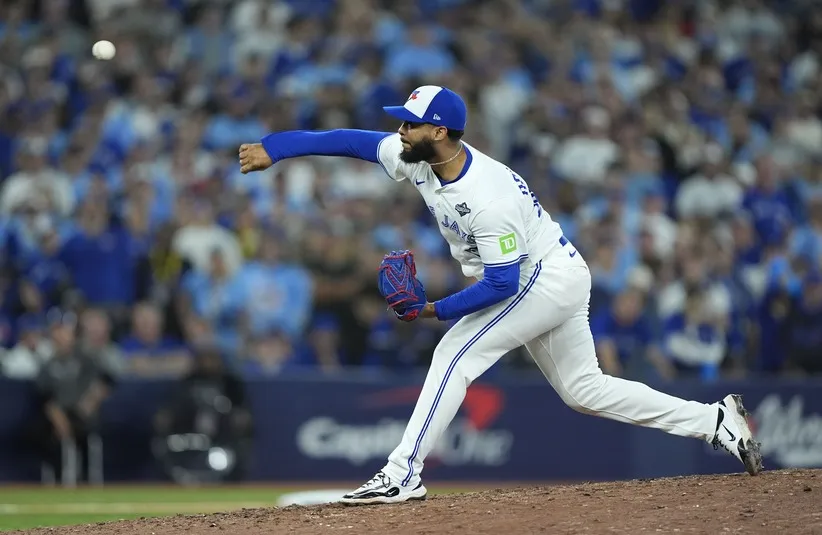
Domínguez was instrumental in the Blue Jays‘ push to the World Series. He pitched to a 3.00 ERA across 24 regular-season games after arriving at the deadline, but it was his postseason work that truly jumped off the page. In 12 playoff appearances, he posted a 2-0 record and a 3.18 ERA.
There is a human element to this signing that stats can’t quantify. Remember Game 7 of the World Series? Domínguez was the one on the mound in the 10th inning, pulling a Houdini act to escape a jam. That level of composure doesn’t grow on trees. For a young White Sox roster trying to learn how to win, having a guy in the clubhouse who has stared down the barrel of a Game 7 and didn’t blink is invaluable.
Analyzing the Pitch Mix: Heat and Movement
If you are wondering what Chicago fans can expect to see, get ready for velocity. Domínguez sits in the 94th percentile for fastball velocity, averaging a blistering 97.7 mph. But in modern baseball, heat isn’t enough. You need movement.
Last season, Domínguez reinvented himself. He introduced a splitter that absolutely devastated hitters, holding opponents to a microscopic .114 batting average with a nearly 50% swing-and-miss rate. When he faces right-handers, he goes to a “sweeper” and a sinker that he likes to pound inside.
Is he perfect? No. He’s a strikeout artist (11.3 K/9 last season), but sometimes the canvas gets a little messy. His walk rate in 2025 was the highest of his career. You are signing up for the “Seranthony Experience.” There might be a walk or two, but he has the stuff to fan the next three guys and end the inning.
Can the White Sox Bullpen Finally Hold a Lead?
The American League Central is often looked at as the little brother of MLB divisions, but that actually works in Chicago’s favor. You don’t need a 100-win super-team to compete here; you just need a roster that doesn’t collapse late in games.
By installing Domínguez as the closer, the rest of the bullpen slots into place more naturally. It takes the pressure off the younger arms and gives Manager Will Venable a legitimate weapon to deploy when the game is on the line.
The White Sox might not be booking their parade route just yet, but for the first time in a long time, the ninth inning doesn’t feel like a foregone conclusion. They traded a star outfielder for depth and a closer, and in the unpredictable economy of baseball, that might just be a winning transaction.