Pulisic vs. the Legends: Inside the Jaw-Dropping USMNT Debate That Won’t Die

Let’s be honest, the ongoing saga surrounding Christian Pulisic and the USMNT has more drama throughout than the Third season of the Original “Jersey Shore.” It’s a classic sports soap opera: the golden boy, the grizzled veterans, and a chorus of talking heads all weighing in on who’s right, who’s wrong, and why everyone should be outraged.
Former USMNT stars, now comfortably positioned behind podcast mics, are lobbing critiques like it’s an Olympic sport. Pulisic and his teammates are firing back, creating a media spectacle that’s become more compelling than some of the actual matches.
As the 2026 World Cup on home soil inches closer, the question isn’t just about formations or tactics; it’s whether this team can tune out the noise, or if they’ll let the ghosts of US soccer’s past derail their future aspirations and dreams in 2026.
The Pulisic Predicament: Can He Handle the Heat?
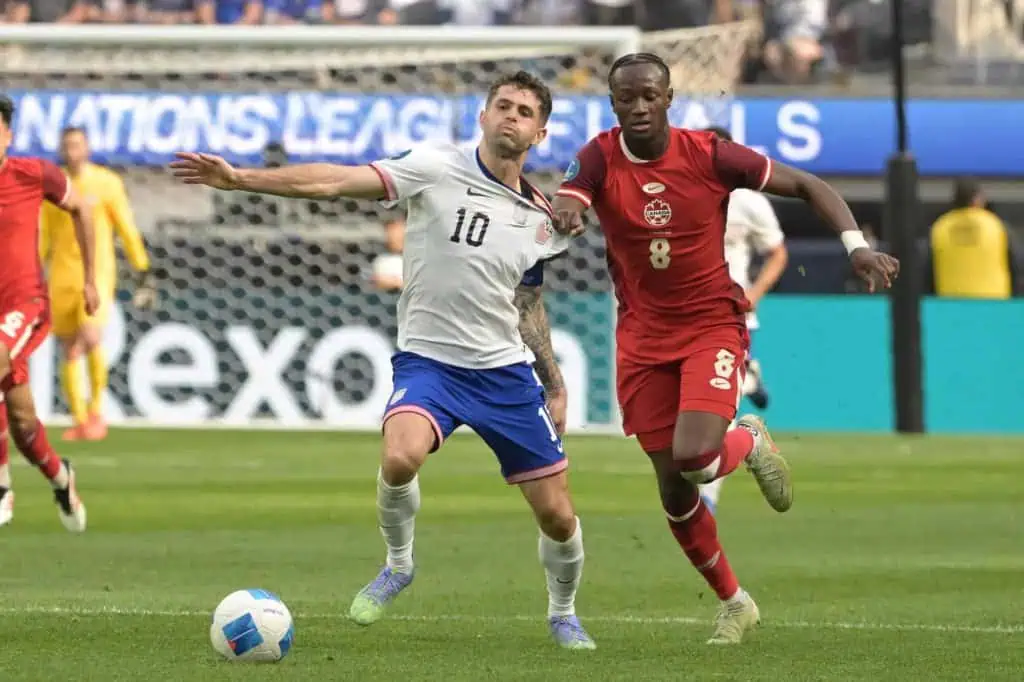
It seems every time Pulisic takes a day off or posts on Instagram, a new wave of outrage erupts from the pantheon of former USMNT players. Legends like Alexi Lalas and Landon Donovan have made a second career out of questioning the commitment and toughness of the current generation. Their latest target? Pulisic and Tim Weah, who dared to want a break after grueling European seasons. The audacity!
Marcelo Balboa, a man who played in three World Cups and helped build MLS from the ground up, seems to be one of the few voices of reason in this mess. “Tell me, what good does it do for me to bash Christian Pulisic or Tim Weah because they wanted a break? It makes no sense to me,” Balboa said.
He’s not wrong. It feels less like constructive criticism and more like a bunch of guys yelling about how much tougher it was back in their day. We get it, you walked uphill both ways in the snow to practice. But times change. Pulisic is playing over 50 games a year against the world’s elite, something the ’94 squad can’t exactly relate to.
A War of Words and Egos
This isn’t just a simple disagreement; it’s a full-blown media war. Pulisic fanned the flames by addressing the criticism in his own documentary, which, let’s face it, was a bold move. Why give your critics more ammo? But Balboa flips the script, asking, “Why is it OK for these ex-players to knock these guys, though?” It’s a fair point. The old guard wants respect, but they seem unwilling to give it. They want to wind people up for podcast clicks, and it’s working.
The whole thing has become a distraction. Instead of focusing on building a cohesive unit for the biggest tournament on home soil since 1994, we’re stuck in a “he said, she said” loop between players past and present. As Tim Weah bluntly put it, “What have we won?” He’s got a point. For all the talk, neither generation has brought home the ultimate prize. Maybe it’s time for everyone to check their egos at the door and focus on the common goal.
The World Cup Pressure Cooker
Playing in a World Cup is hard enough. Playing one at home? The pressure is monumental. Balboa knows this firsthand, having been part of the ’94 squad that defied expectations on American soil. “You don’t need your own country, your own ex-players, beating you up while you’re trying to get prepared for the biggest tournament in the world,” he stated.
His advice to the current team is simple: let it go. “Who cares what they say at the end of the day? You’ve got to do your job.” It’s easier said than done, but it’s the only path forward. The legacy of Christian Pulisic and this team won’t be defined by Twitter spats or documentary soundbites.
It will be defined by what the U.S. does on the pitch in 2026. They can either silence the critics with a historic run or prove them right by crumbling under the weight of it all. The clock is ticking, and the whole world, including the ghosts of US soccer’s past like Landon Donovan and Tim Howard, are watching this team.